 how-to
Laser Therapy Sessions for Inflammation: How Many You Need
HealthSource Chiropractic of Greensboro’s Class IV Laser is helping patients heal faster and stay healthier longer every day!
Last Updated: November 9, 2026
Quick Summary
Laser therapy sessions for inflammation typically range from 4 to 6 sessions for acute injuries and 10 to 15 sessions for chronic inflammation. Your provider sets the exact count during an evaluation based on severity, timing, location and how your body responds in the first two weeks.
- If you feel no change after 4 sessions, the plan needs adjusting, not extending.
- Chronic low back pain plans typically run 12 to 20 sessions at 1 to 2 per week.
- Class IV laser treatment duration is typically 5 to 10 minutes per session.
- Acute pain is scheduled 2 to 3 times weekly; chronic pain 1 to 2 times weekly.
- Schedule laser sessions before PT appointments so you arrive at rehab with less pain.
Table of Contents
- How Many Laser Therapy Sessions for Inflammation?
- Acute Inflammation: The 4 to 6 Session Range
- Chronic Inflammation: The 10 to 15 Session Range
- How Long Does Laser Therapy Take to Work?
- Low-Level Laser Therapy Dosage: What the Numbers Mean
- What Changes Your Session Count: Condition, Severity and Timing
- What to Expect During a Laser Therapy Session
- Keeping Results After Your Last Session
- Book a Laser Therapy Consultation
- Frequently Asked Questions
How Many Laser Therapy Sessions for Inflammation?
Session counts for laser therapy vary with the type and duration of inflammation, and they are set during an evaluation rather than as a fixed number. General treatment protocols distinguish between recent injuries and long-term inflammatory pain.
At HealthSource Chiropractic of Greensboro, our care plans are tailored to each patient's condition. Here is the short version before we get into the details.
Laser therapy sessions are the individual appointments in a care plan that uses focused light to calm inflamed tissue and support repair. The count depends on how long the inflammation has been there, how severe it is, and how your body responds in the first two weeks.
Below, we break down the ranges by condition type, explain how long results take, and show what actually changes your session count.
Acute Inflammation: The 4 to 6 Session Range
Fresh injuries generally respond faster than long-standing inflammation. A recent strain, a flare-up after a weekend of yard work, or a sudden onset of neck pain is typically assessed case by case by a qualified provider.
Why so few? Acute inflammation is a short-term response. Tissue is irritated but not yet remodeled. Light energy at the right dose can quiet that response quickly.
Scheduling is set by your provider based on your evaluation. A recheck partway through a plan helps confirm whether you are progressing as expected.
If you feel no change after 4 sessions, the plan needs adjusting, not extending. That is a conversation to have with your provider, not something to push through.
Chronic Inflammation: The 10 to 15 Session Range
Long-standing inflammation generally needs more time than an acute injury. The length of any plan is determined during your evaluation.
That is not padding. Chronic inflammation involves changed tissue, altered movement patterns, and often a nervous system that has been sensitized for months or years.
Scheduling for chronic pain is set by your provider based on your evaluation.
A peer-reviewed review of low-level laser therapy for inflammation describes dosing in the range of 5W/cm² applied for 30 to 60 seconds a few times per week to painful sites. Dose and frequency work together, which is why a chronic plan looks different from an acute one.
For a broader look at how chiropractic laser therapy addresses inflammation, see our guide to chiropractic laser therapy for inflammation relief.
How Long Does Laser Therapy Take to Work?
Changes often build gradually over a plan rather than after a single visit.
Results vary between individuals, and a provider can discuss expected progress during your evaluation.
Consistent attendance is generally part of a treatment plan, and your provider can explain how it applies to your care.
Low-Level Laser Therapy Dosage: What the Numbers Mean
Dosage is where laser therapy gets technical, and where most online guides stay vague. Here is what the numbers actually control.
Wavelength sets how deep the light reaches. Longer wavelengths penetrate deeper tissue, which matters for hip, shoulder, and low back targets.
Power density is the concentration of energy at the treatment site. The NIH-published research on low-level laser therapy dosing describes power densities around 5W/cm² applied for 30 to 60 seconds per painful site.
Treatment duration is determined by your provider for each session.
Frequency is how often you come in, and it is set during your evaluation.
Dosing is adjusted by a trained provider based on your response rather than running the same setting every time.
Want to see how laser classes and dosing compare with other pain treatments? Read our breakdown of laser therapy for pain versus traditional treatments.
What Changes Your Session Count: Condition, Severity and Timing
No two care plans match, and that is correct. Several factors move the number up or down.
- Condition type: acute injuries sit at 4 to 6 sessions; chronic conditions at 10 to 15 (ACA-DE, 2026; Delmarva Chiropractic, 2026)
- Severity: higher pain scores and longer symptom history usually mean more visits
- Timing: treating within days of an injury often shortens the plan
- Location: deep joints and dense tissue need different dosing than the neck or wrist
- Your response: how you react in the first two weeks is the strongest predictor of total sessions
- Adherence: missed visits slow the cumulative effect and stretch the timeline
One honest caveat: research on laser therapy still debates standardizing dosage, and clinical evidence has limits (PMC - NIH, 2019). A good provider tells you this up front.
Condition-Specific Session Calculators
Use these starting estimates, then confirm with a provider:
Condition | Typical Sessions | Frequency | Notes |
|---|---|---|---|
Acute neck or back strain | 4 to 6 | 2 to 3 per week | Recheck at session 3 |
Chronic low back pain | 10 to 15 | 1 to 2 per week | Full plans run 12 to 20 |
Post-surgical inflammation | 8 to 12 | 2 per week | Coordinate with your surgeon |
Sports injury | 4 to 8 | 2 to 3 per week | Pair with rehab work |
Degenerative arthritis flare | 10 to 15 | 1 to 2 per week | Maintenance may follow |
Typical Sessions
Treat these as planning numbers, not promises. Your evaluation sets the real count.
What to Expect During a Laser Therapy Session
Appointment lengths and what to expect are reviewed with you by your provider. Here is an overview of what a visit typically involves.
Here is the actual flow, with the clinical specifics that change your outcome:
- Brief check-in and pain mapping. Your provider asks about pain levels, changes since last visit, and any new flare-ups. Some clinics use a simple body diagram to track where inflammation has moved. This takes 2 to 3 minutes and directly informs the dose you receive that day.
- Positioning and skin preparation. You lie or sit comfortably with the treatment area exposed. The provider may clean the skin and, for Class IV lasers, confirm that the device is in a controlled area with proper eye protection for everyone in the room. Safety protocols for laser equipment, including eye protection, are followed during treatment.
- Laser application with real-time dose adjustment. A handheld device moves over the target area in a grid pattern. You feel warmth, not pain. For a Class IV laser, treatment duration is typically 5 to 10 minutes per session (Calibration Physical Therapy, 2026). The provider adjusts power density and duration based on your tissue response, not a fixed preset. The NIH-published research on low-level laser therapy dosing describes power densities around 5W/cm² applied for 30 to 60 seconds per painful site, but that is a starting point, not a universal protocol.
- Post-treatment check and scheduling. You and your provider note any immediate changes (often subtle, like easier movement or less stiffness). The next visit is scheduled at the frequency your plan calls for: 2 to 3 times weekly for acute pain, 1 to 2 times weekly for chronic pain (Dakota Chiropractor, 2026).
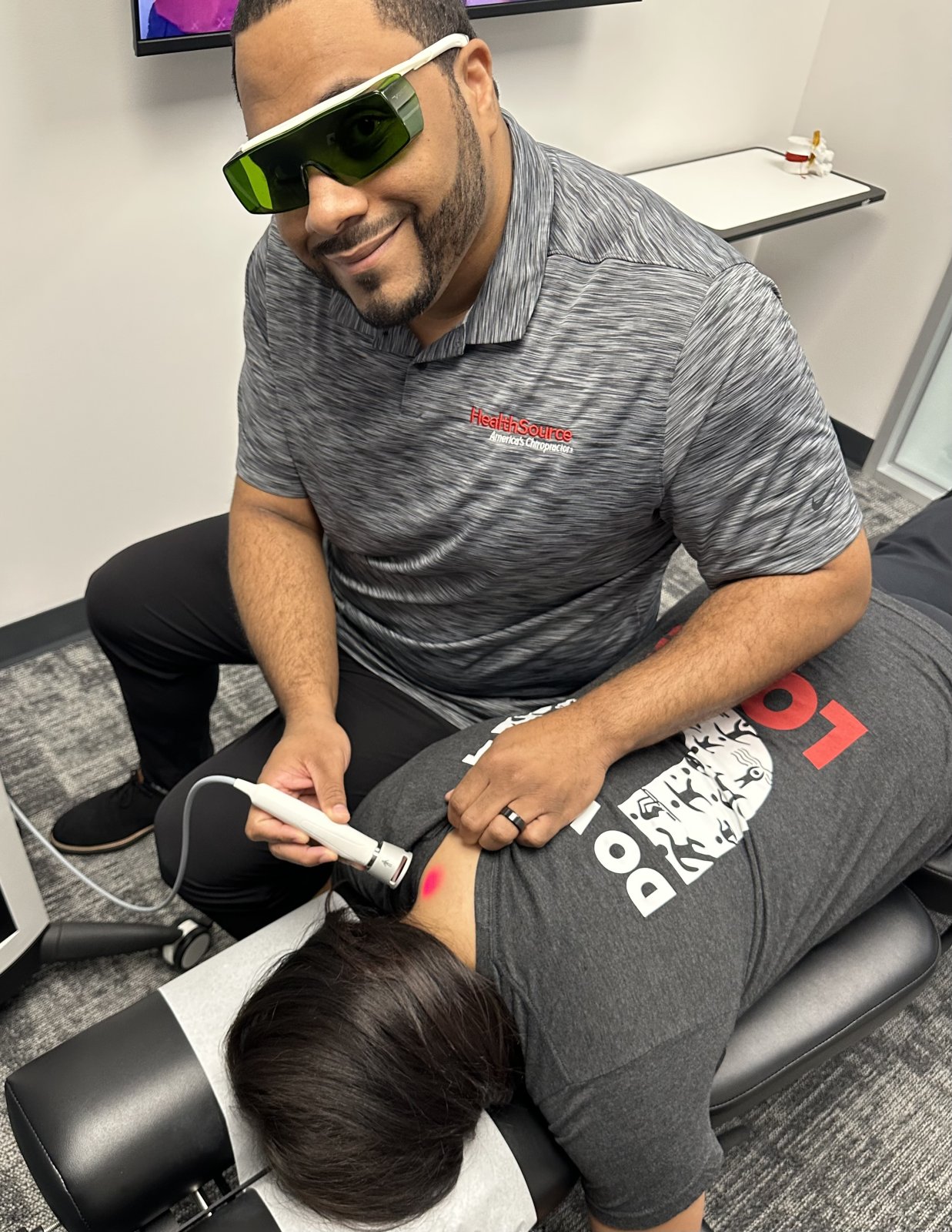
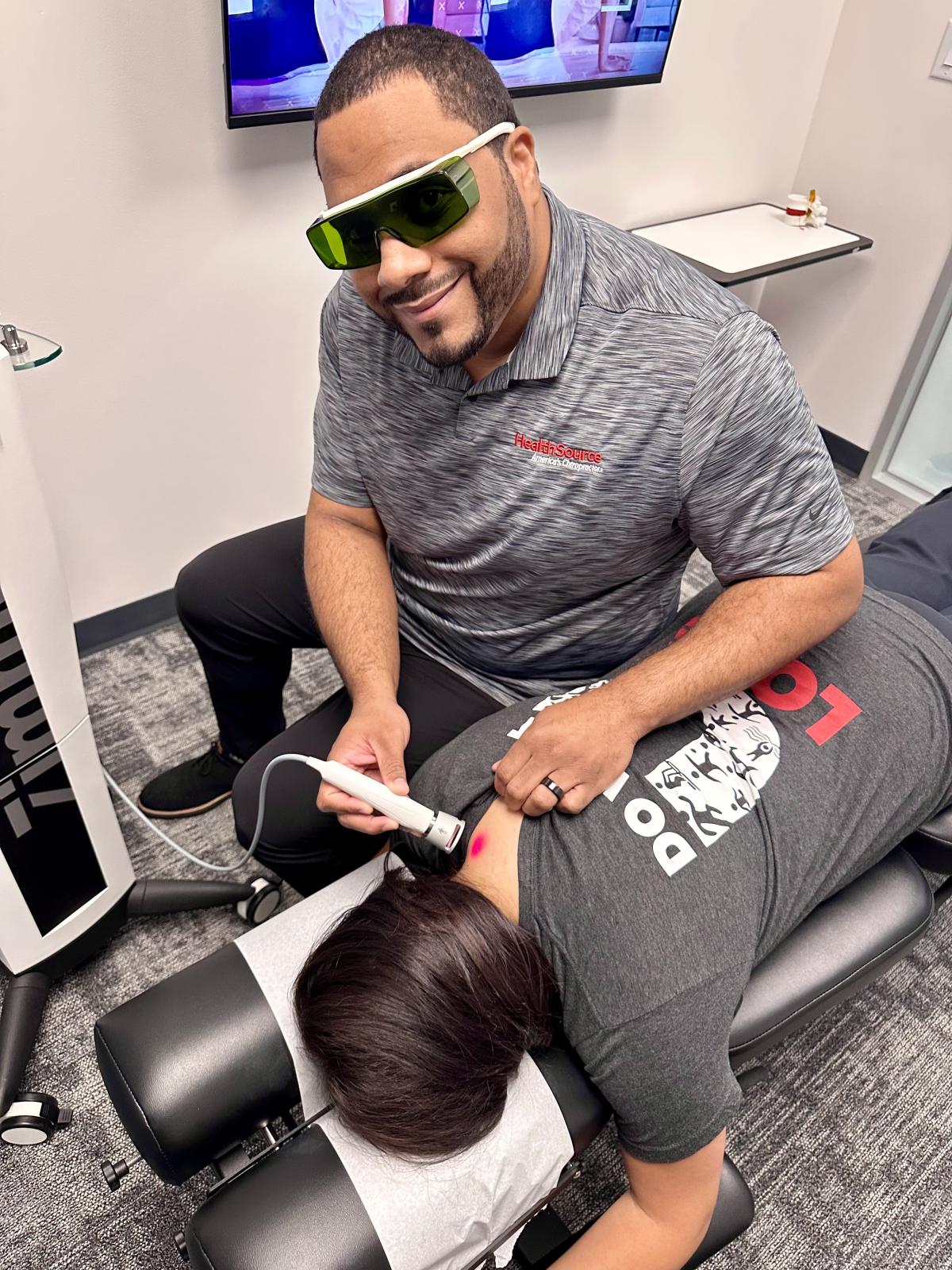
Dr. Everett Tucker with HealthSource Chiropractic of Greensboro’s Class IV Laser
Watch out: If a clinic runs the same laser settings on every patient regardless of condition or response, ask why. Dose should change as your tissue responds, and a fixed protocol is a red flag for cookie-cutter care.
For a deeper look at how laser therapy supports healing, read the healing and pain-relieving powers of laser therapy.
Keeping Results After Your Last Session
The last session is not the finish line. Inflammation that returns usually means the underlying cause was never addressed. Maintenance after your plan ends can help support your progress. Here is the maintenance protocol that keeps gains from slipping.
Why maintenance matters. Laser therapy works through a cumulative effect, and that effect fades if the tissue is not retrained. Light calms the tissue. Movement retrains it. Skip the second part and the same pain tends to come back.
Condition-specific maintenance schedules. These are starting points, not promises:
Condition | Post-Plan Maintenance | Booster Session Frequency |
|---|---|---|
Acute strain (resolved) | Home exercise for 4 to 6 weeks | None unless flare-up |
Chronic low back pain | Daily mobility work; strength 3x/week | 1 session every 4 to 6 weeks for 3 months |
Degenerative arthritis | Joint-friendly movement daily | 1 session every 4 to 8 weeks, ongoing |
Post-surgical inflammation | Coordinate with surgeon's rehab protocol | As directed by surgeon or PT |
Sports injury | Return-to-sport progression | 1 session before and after high-load weeks |
Booster sessions explained. A booster is a single session that may be considered to address a new flare-up. Whether one is appropriate is decided during your evaluation.
Integration with physical therapy. Laser therapy complements active rehabilitation by reducing pain enough that you can do the exercises that actually remodel tissue. If you are working with a physical therapist, schedule laser sessions before PT appointments when possible. That way you arrive at rehab with less pain and can tolerate more load.
Home program essentials.
- A home exercise routine built around your weak links, not generic stretches
- Posture and workstation changes for desk-related neck pain
- Periodic check-ins if you have a degenerative condition
- Early treatment of new flare-ups instead of waiting months
Patients who stay consistent with their home program tend to hold their gains longer. You can read real patient testimonials about results after care ends.
Book a Laser Therapy Consultation
The right number of laser therapy sessions for inflammation is the number your body actually needs, and that starts with an exam, not a guess.
Bring your questions. Ask about dose, frequency, and what progress should look like by week two. A good plan has checkpoints built in.
At HealthSource Chiropractic of Greensboro, we combine Class IV laser therapy with chiropractic adjustments, Progressive Rehab®, and functional exercise into one plan aimed at the root cause of your pain. More than 20,000 patients rate their experience 5-stars, and our care plans are personalized to each patient.
You can explore our laser therapy services for pain and see what a first visit involves.
Chronic inflammation rarely fixes itself, and waiting usually costs more visits later than starting now. HealthSource Chiropractic of Greensboro offers Class IV laser therapy, Progressive Rehab®, and spinal decompression under one roof, so your plan addresses both the pain and the reason it keeps returning. Get started with HealthSource Chiropractic of Greensboro and build a care plan around your actual condition.
Frequently Asked Questions
Does laser therapy work for inflammation?
Yes, laser therapy is used to reduce inflammation. Photobiomodulation, the process behind low-level laser therapy, targets tissue repair and cellular metabolism, and laser therapy dosing is set by a clinician based on the individual case. That said, the evidence base is still developing, and results vary by condition. A clinician can tell you whether it fits your specific case alongside other care.
How long does it take for laser therapy to show results for inflammation?
Some patients notice improvement within the first week or two, while others need several sessions before a change is measurable. Because results can build over time, a provider typically reassesses progress at set intervals rather than judging the outcome after one visit.
Is there a limit to how many laser therapy sessions I can receive?
The number of sessions is determined by your evaluation. After an initial course, a provider may recommend a maintenance schedule. Your clinician should reassess progress at planned checkpoints and adjust the plan if you are not improving, so you are not paying for sessions that are not helping.
What factors influence the number of laser therapy sessions I need?
The biggest factors are whether your inflammation is acute or chronic, how long you have had the problem, the tissue involved, and how consistently you attend. Acute and chronic conditions are assessed differently, and your provider will determine the appropriate number of sessions. Your provider may also combine laser therapy with chiropractic adjustments, Progressive Rehab or spinal decompression, which can change the overall timeline.
See for yourself, Book now by calling 336-790-5088 or click this link to book online now: https://www.healthsourcechiro.com/location/greensboro/schedule-appointment/?gf_page_2=1