 blog
How to Build Rehab for Athletes That Restores Performance
Last Updated: October 25, 2026
Quick Summary
Rehab for athletes is a structured, sport-specific recovery program that rebuilds strength, movement quality, and confidence after injury, with every stage tied to the demands of your sport rather than just daily function. It follows five stages: diagnosis, inflammation control, healing support, fitness rebuild, and load control.
- The five stages are diagnosis, inflammation control, healing support, fitness rebuild, and load control.
- Most re-injuries trace back to a rushed jump from stage three to stage five.
- Sleep is the single biggest recovery tool you have.
- Return to play should be decided by objective testing, not a date on the calendar.
- A common strength benchmark is within 90% of the uninjured side.
Table of Contents
- What Sports Rehabilitation Does That General Physical Therapy Doesn't
- Sports Rehab Exercises That Rebuild Strength and Movement
- Recovery Techniques for Athletes: What Helps and What's Hype
- Return to Play After Injury: Criteria, Not Calendars
- How Sports Physical Therapy and Chiropractic Care Work Together
- The Mental Side of Injury Recovery
- Choosing a Qualified Sports Rehabilitation Provider
- Scheduling Your Sports Injury Assessment
- Frequently Asked Questions
What Sports Rehabilitation Does That General Physical Therapy Doesn't
Rehab for athletes is a structured, sport-specific recovery program that rebuilds strength, movement quality, and confidence after injury. It goes further than general physical therapy because every stage is tied to the demands of your sport, not just to daily function.
That difference matters. The review of sports injury rehabilitation concepts reports that 39.8% of injured athletes returned to sport in one analysis, while a recent meta-analysis cited in the same review reported 83%. The gap is huge, and it tells you something important: how you rehab decides whether you get back.
At HealthSource Chiropractic of Greensboro, we build rehab for athletes around Progressive Rehab® and functional exercise. The goal is simple. Restore how you move, then rebuild how you perform.
The Five-Stage Rehabilitation Process
Recovery is not one step. A 2011 clinical review of athlete rehabilitation describes five stages: diagnosis, controlling inflammation, promoting healing, increasing fitness, and controlling abuse. That last one means stopping the habits that caused the injury in the first place.
Here is how those stages look in practice:
- Diagnosis - Find the real cause, not just the sore spot
- Inflammation control - Calm the tissue down early
- Healing support - Give tissue what it needs to repair
- Fitness rebuild - Restore strength, mobility, and endurance
- Load control - Manage training volume so you don't re-injure
Skip a stage and you pay for it later. Most re-injuries trace back to a rushed jump from stage three to stage five.
Sports Rehab Exercises That Rebuild Strength and Movement
Sports rehab exercises work by loading tissue in a controlled way, then adding complexity as your body adapts. The best programs move from basic movement patterns to sport-specific training, with clear milestones at each step. Generic week-by-week timelines are a starting point, but the exercises that actually rebuild an athlete depend on the injury, the sport, and the tissue involved.
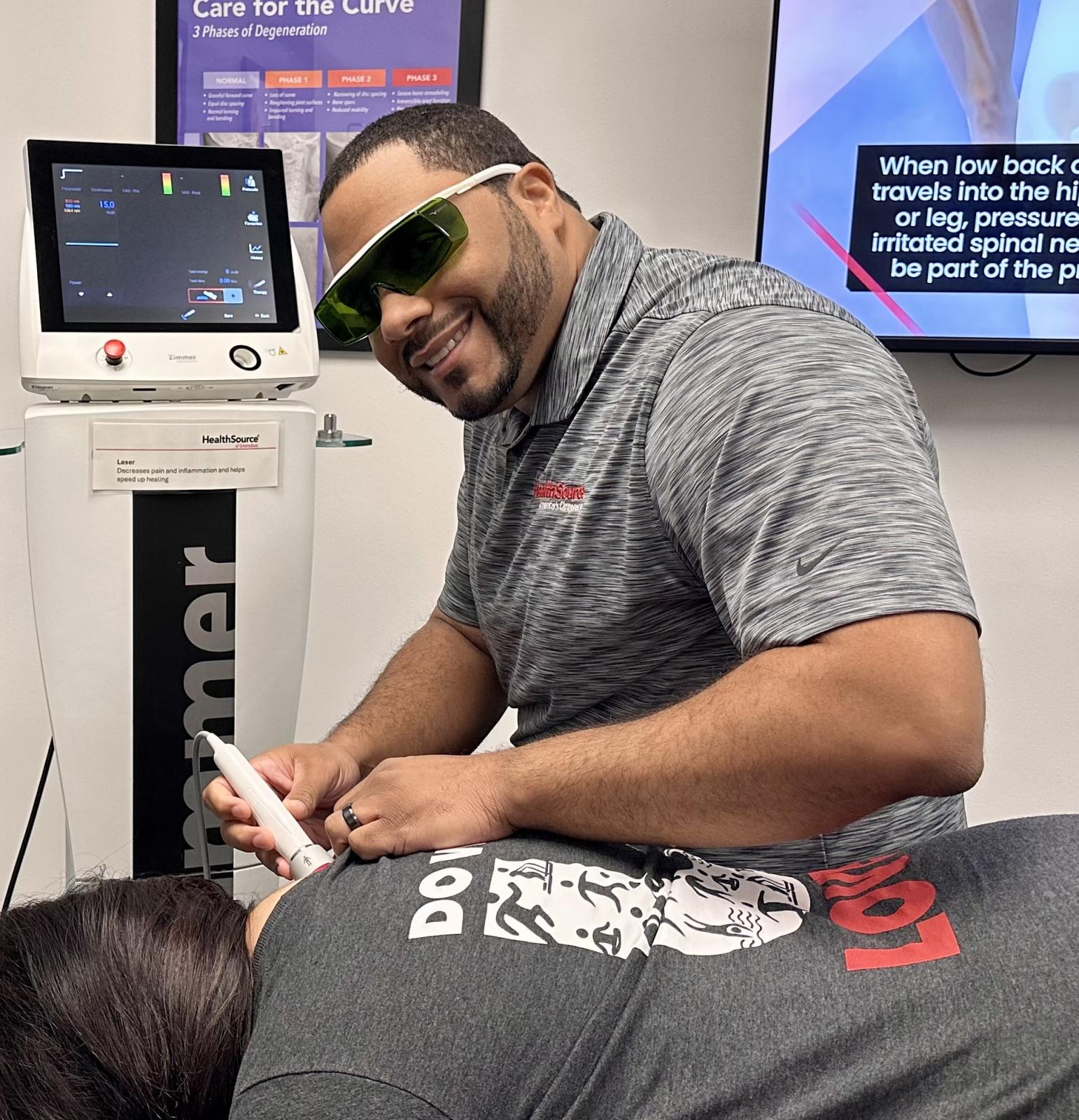
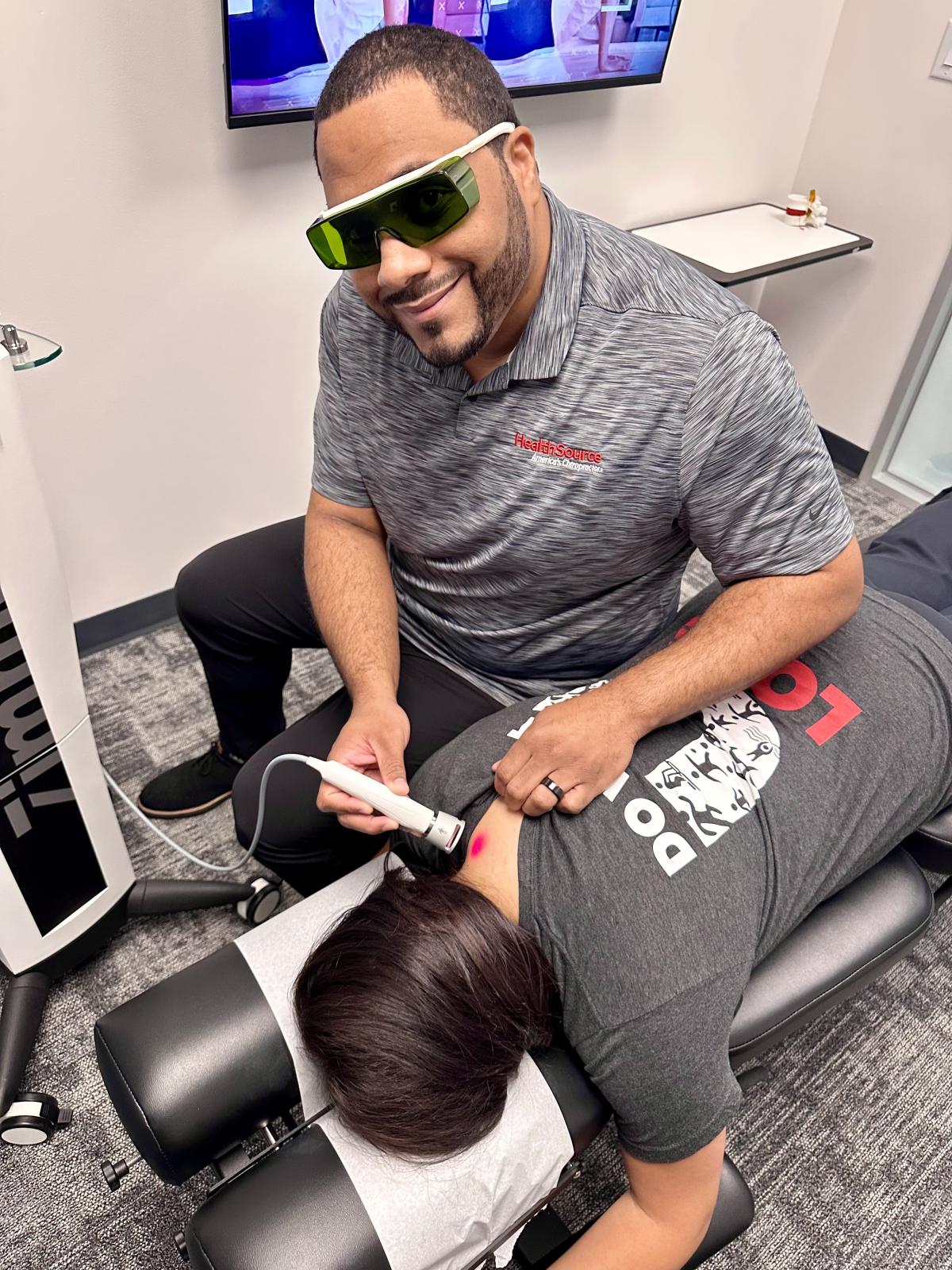
Dr. Everett Tucker, DC with Class IV Laser
The sequence matters more than the exercises themselves. We start with range of motion and flexibility, add strengthening work, then build balance and coordination. Speed, power, and endurance come last. Within that sequence, the specific exercises should match the injury pathway.
Injury-Specific Exercise Pathways
Ankle sprain. Early work focuses on pain-free ankle range of motion (ankle alphabet, seated calf raises), then progresses to single-leg balance with eyes open and closed, heel raises, and lateral band walks. Late-stage work adds hopping, cutting, and change-of-direction drills that mimic the sport's demands on the ankle.
ACL reconstruction. Rehabilitation is longer and more structured. Early phases emphasize quadriceps activation (quad sets, straight-leg raises), then closed-chain strengthening (leg press, mini squats), then single-leg work and neuromuscular control. Late-stage work includes plyometrics, agility drills, and sport-specific cutting before any return-to-sport testing.
Hamstring strain. Early work protects the tissue with gentle isometric contractions, then progresses to eccentric loading (Nordic hamstring curls, Romanian deadlifts), then to high-speed running and sprint mechanics. The eccentric phase is where most of the reinjury protection is built.
Shoulder injury. Rotator cuff and scapular control exercises come first (band external rotation, scapular retraction), then overhead strengthening, then throwing or sport-specific overhead patterns. Overhead athletes need a throwing progression, not just general shoulder strengthening.
A Sample Exercise Progression
Here is how a typical progression runs over several weeks, with the understanding that the specific exercises change by injury:
- Weeks 1-2: Gentle range of motion and stretching
- Weeks 3-4: Bodyweight strengthening exercises
- Weeks 5-6: Single-leg balance and coordination drills
- Weeks 7-8: Sport-specific movement patterns
- Weeks 9+: Speed, power, and full training loads
If you're dealing with overuse pain from repetitive strain, chiropractic care for repetitive stress injuries addresses the root cause instead of just the symptom.
Elbow and forearm issues from racket or club sports follow their own path. Our team offers targeted care for tennis elbow and golfer's elbow when those joints are the problem.
Recovery Techniques for Athletes: What Helps and What's Hype
Recovery techniques for athletes fall into two groups: those with solid evidence and those with great marketing. Sleep, nutrition, hydration, and active recovery have the strongest support. Cryotherapy and compression gadgets get more attention than they deserve.
What actually moves the needle:
- Sleep - The single biggest recovery tool you have
- Nutrition - Protein and carbs after training, consistently
- Hydration - Simple, cheap, and easy to skip
- Active recovery - Light movement on rest days
- Rest days - Scheduled, not accidental
What's mostly hype: ice baths for muscle growth, compression boots as a substitute for sleep, and any device promising faster healing without the boring basics.
Return to Play After Injury: Criteria, Not Calendars
Return to play after injury should be decided by objective testing, not by a date on the calendar. A 2017 review of return-to-play guidelines notes that return should be agreed using objective information about recovery, fitness status, and the athlete's own perspective. That means strength symmetry, pain-free range of motion, and sport-specific testing. Not "six weeks is up, you're cleared."
Objective Testing Criteria
A complete return-to-play decision usually rests on several measurable checkpoints:
- Pain-free range of motion, The injured joint should match the healthy side within a few degrees on goniometric measurement.
- Strength symmetry, A common benchmark is within 90% of the uninjured side on isometric or isokinetic testing for the involved muscle groups. Some clinicians use 85-90% as a minimum, with higher thresholds for power athletes.
- Functional hop tests, Single-leg hop for distance, triple hop, crossover hop, and timed hop are compared side to side, again looking for roughly 90% symmetry.
- Balance and proprioception, Single-leg stance time and reach tests (such as the Y-balance test) help confirm movement control before loading.
- Sport-specific drills, Sprinting, cutting, decelerating, throwing, or jumping at full speed in a controlled setting before full contact or competition.
- Clinician clearance, A qualified clinician reviews the test results alongside the athlete's own confidence and the coaching staff's input.
Milestone | What It Measures | Why It Matters |
|---|---|---|
Pain-free range of motion | Joint mobility | Basic tissue readiness |
Strength symmetry (≈90%) | Injured vs. healthy side | Reinjury risk |
Hop and balance tests | Movement control | Sport-specific readiness |
Sport-specific drills | Real movement quality | Return to play decision |
Clinician clearance | Integrated judgment | Final safety check |
Why Time Alone Fails
A calendar-based return ignores how differently two athletes can heal from the same injury. One athlete may pass strength and hop tests at eight weeks; another may need twelve. Using time as the primary criterion raises reinjury risk, especially in sports that demand cutting, jumping, or overhead motion. The better approach is to set time as a minimum window, then let objective testing decide the actual return date.
If you're weighing treatment options for lingering upper or lower limb pain, lower and upper extremity pain care walks through what we offer.
How Sports Physical Therapy and Chiropractic Care Work Together
Sports physical therapy and chiropractic care complement each other. Physical therapy rebuilds strength and movement patterns. Chiropractic adjustments restore joint motion so those patterns can actually hold.
For athletes, that combination often means less pain and better movement quality. Our chiropractic adjustment for sports injury recovery approach focuses on the joint restrictions that limit performance.
The Mental Side of Injury Recovery
Confidence comes back slower than tissue does. An qualitative study of elite athletes' rehabilitation experiences found that injury recovery is shaped by biological, psychological, and social factors interacting together, not just physical healing.
That's why we set small, visible milestones. Each one rebuilds trust in your own body.
Choosing a Qualified Sports Rehabilitation Provider
Look for three things: a clear assessment process, a personalized treatment plan, and honest return-to-play criteria. Ask how they measure progress and who decides when you're cleared.
A good provider will explain the plan in plain language, adjust it as you improve, and never rush you back.
Scheduling Your Sports Injury Assessment
The fastest path back to performance starts with a proper assessment. At HealthSource Chiropractic of Greensboro, we combine chiropractic care with Progressive Rehab®, functional exercise, and therapies like class IV laser treatment and spinal decompression.
You get a personalized plan, clear milestones, and a team that explains every step. See our new patient offer and book your assessment.
Frequently Asked Questions
What are the three phases of injury recovery?
Recovery is usually described in overlapping phases: the acute phase, where the focus is diagnosis and controlling inflammation; the healing and strengthening phase, where tissue repair is supported with progressive loading and mobility work; and the return-to-sport phase, where sport-specific training and objective testing decide readiness. A 2011 review in PubMed Central breaks the process into five steps: diagnosis, controlling inflammation, promoting healing, increasing fitness, and controlling abuse. Most athletes move through them faster when the plan is personalized to the injury and sport.
How do you know when you're ready to return to sport?
Readiness comes from objective information, not a fixed number of weeks. A 2017 article in Apunts Sports Medicine says return to play should be agreed upon using objective information about injury recovery, fitness status, and the athlete's own perspective. In practice that means passing strength and movement tests, matching pre-injury performance benchmarks, and completing sport-specific drills without pain. Confidence matters too. If you hesitate on cutting or landing, you are not ready yet, even if the calendar says you are.
What are the best recovery techniques for athletes?
Sleep, hydration, and adequate nutrition do more for recovery than most gadgets. Active recovery, such as easy cycling or walking on off days, keeps blood moving without adding strain. Stretching and mobility work protect range of motion, and structured rest days prevent overtraining. Cryotherapy and compression may help you feel better, but they do not replace progressive strengthening. Build recovery techniques around the basics first, then add tools that fit your sport and schedule.
How does sports rehabilitation help athletes return to play?
Sports rehabilitation treats the whole path back to competition, not just the sore spot. It starts with a clinical and biomechanical assessment, then builds a personalized treatment plan around your sport's demands: strength, mobility, balance, and coordination. Progressive loading restores tissue capacity, and sport-specific training rebuilds speed, power, and endurance. Because return-to-sport criteria are tested rather than assumed, rehab for athletes lowers reinjury risk and gives you a clearer timeline. A provider can also flag when imaging or a physician referral is needed.
Your body has a comeback in it. The question is whether your rehab is built to find it. Get started with HealthSource Chiropractic of Greensboro and rebuild the strength, movement, and confidence you had before the injury.